Deconstructing Gender: An Exploration of the DIY Music Scene and Societal Norms
Introduction
Activism can take on many different forms and be done in various ways, but there is one thing that one must do: to Act. Without action, there is no rebellion. Whether this is a riot, strike, or protest where one is out on the streets, shouting and demanding their rights, or producing material criticizing the current system, such as a zine, newspaper, or a pamphlet, one must put themselves out there and rebel, go out of what is considered decent and ordinary.
Although rebellion isn’t always necessarily activism as much as it is a rejection of the norm through self expression, as the simple act of being yourself can also be turned into something political by those who enforce a set of rules and punish anyone who doesn’t fit them. With the current climate in the western world and the rise of transphobia in media and society in the recent years, there is even more of an emphasis on ‘what it means to be trans, why it is wrong, dangerous and should be stopped’. In this climate, is existing and living life as a trans person, by itself, also a sort of activism? To challenge gender norms, and to be your true self?
This paper will be concerned with the topic of transgender influence on music, namely in the genre of hyperpop, and attempt to answer the question, “How is the D.I.Y. music scene related to the deconstruction of gender norms?” While the focus will be on what music production means regarding gender expression, this paper also talks about the music industry in general, D.I.Y. communities, and known transgender artists and producers. The main objective is to bring attention to the social construct of gender, and how closely related it is to D.I.Y. culture and what it stands for, by discussing self expression and genre-bending.
The Constrictions of Production and Gender
In mainstream media outlets and generally on social media, D.I.Y. is usually portrayed as decorations, quick solutions to problems you might find yourself in, or something concrete, tangible. In reality, D.I.Y. can be anything one makes of it, even something absurd or hard to grasp for many. As a concept, it has so much more to offer to society, communities and individuals. To do something yourself is to take the reigns and to create something with your own hands, your own ideas, to fit your wants and needs.
Often times, to do something on your own is seen as simple, messy, maybe unprofessional, but that is the essence of it: D.I.Y, at its core. Everyone can participate in it, without restrictions, and it can be as simple as making anything. It is flexible, therefore accessible. As broad as the term is, the main idea of it is simple: as the name states, It is something you Do, Yourself.
Similarly, gender can be explained in similar terms. Judith Butler, in their critically acclaimed work Gender Trouble (1990), refers to gender as something one “does”. They talk about the social construction of gender and how we perform the roles we believe fit the binary conditions of our society, depending on the culture we are surrounded by. Considering gender to be sociological rather than biological or “natural” also opens up the conversation about how what most believe is inherent to the nature of the so called two sexes, are in reality a result of repeated performances throughout centuries, of the roles that are decided by various power structures and forced upon us. Butler’s main belief is that by coming to realize the social construction of the binary gender, we as humanity are more likely to subvert it.
The idea of gender outside the binary, which can also be reffered to as non-binary, is a rebellion against the systems in place that benefit from the binary. From a consumerist perspective, one of the easiest given examples for this is marketing strategies, and how it differs for men and women. There are clear cut rules for what men should get, and what women should. Everything is readily separated accordingly to a certain set of rules that are accepted to be universal and true: clothing stores have different departments for men and women, and they not only differ in style and shape but also in terms of how the sections are decorated, so much so that we are able to automatically determine whether we are at a “masculine” or “feminine” part of the same store, despite the fact that clothes have nothing that would be used to determine gender in a human body, biologically or physically.
Femininity and masculinity have no inherent value besides what has been attributed to them, but because corporations depend on consumers to adhere to the very strict set of rules of gender, they plan and market accordingly, to easily feed into mass production and consumption culture. Therefore, rejection and “queering” of gender goes directly against corporative greed as well.
Where does D.I.Y. come into play, and how can we link the concept of gender and creativity? Simply put, destruction of the binary is a process of creativity too, in a way. Looking at what others consider to be clear cut and straightforward and making something new out of it. In fact, many people who identify as outside the binary use the concept of gender and masculinity or femininity as a mere suggestion, and “do” something with them accordingly with how they feel about their own bodies, minds, and expressions of self. They Do, Themselves.
Individuality in the Music Industry and Rise of Hyperpop
Production in the music industry had already been shifting away from a company and label focused reality to one where artists are at the forefront. There has been a prominent rise in popularity of indie music where smaller, individual artists got attention and gained a large fanbase as a result. In recent years, the term “Bedroom music” has been coined and popularized where a person simply makes and releases self produced songs “from their bedrooms”. This can also be divided into subgenres, such as bedroom pop with a popular artist being Clairo’s music. Following this, during and after the pandemic, many creatives started sharing self-produced music, promoting themselves on the social media app TikTok, without a record label deal. With TikTok’s focus on music and sound, and the algorithm that pushes content to the people who would be interested in them, people were able to jumpstart their careers without a record label deal. One example is hemlocke springs, who went viral with her song “girlfriend” and gathered a lot of attention, later releasing a music video.
These musicians aren’t professionals, nor do they have access to any resources that they would have with a contract and connections. So many of the people behind the music released today are students, freelance workers, or anyone who has a computer and the means to create, and essentially, this is a shift into D.I.Y. as well. Of course, there are still professional artists who are much more popular on a larger scale, but the current state of the music industry is allowing more creative freedom for anyone who wants to share their creativity with the world.
Another shift in the music industry and music itself, in accordance with self-produced craft, has been the various subgenres. Spotify has found a way to monetize the recent obsession with not only individuality but also perceived uniqueness, presenting its users with listening statistics at the end of every year with “Spotify Wrapped”, listing a handful of genres that are unheard of in the mainstream. However, the company is hardly responsible for the creation of these subgenres, as that can mostly be credited to artists themselves, especially those in marginalized communities challenging and bending the rules of music genres.
In this way, genre-bending can be compared to the queering of gender: both are concerned with taking a set of rules of a certain category and bending them to their own will.
Hyperpop as a genre is fairly new: the origins of it can be traced back to the record label PC Music, established in 2013 by A. G. Cook, and its artists. It can also be considered part of bedroom music, in similar fashion, as most producers of this genre are those who create music by themselves and post it online. Producers of this genre usually refuse to define it as anything concrete or sensible, which is part of the charm of it, too. However, there is a certain sound or image that comes to mind when one thinks of what hyperpop is, or what is means.
Patrick Williams (2021), talks about the genre and how it’s identified in his thesis: “Many Hyperpop songs have similar characteristics despite this resistance to definition. Absurdity and exaggeration are central to Hyperpop, as artists twist the proverbial dials of pop music customs to their extremes. For example, synths are punchier or more mellifluous, basses are boomier, lyrical hooks are catchier, and curated aesthetics are given a more polished sheen.” (p. 2)
The stylization of hyperpop cannot be credited directly to a singular person, but one of the most prominent figures of this genre and a Grammy winning producer responsible for many commercial and otherwise well-known hits, is Sophie Xeon, also known as SOPHIE. Some of her most popular works are her collaborations with and productions for big names like Charli XCX, Madonna and MØ. Her 2018 critically acclaimed album OIL OF EVERY PEARL’S UN-INSIDES which contains the songs ‘Immaterial’ and ‘Faceshopping’. The name can also be read as “I love every person’s insides” when spoken out loud.
In SOPHIE’s personal work, the visuals she uses, her vocal arrangements, and her style of production is directly linked to her experience as a trans woman. With the main message and the lyrics about existentialism, reality and change, being who you want to be; with visuals that transcend and disfigure material existence, SOPHIE’s music takes the form of herself, while also refusing to take form at all.
Transhumanism, as a concept, is used to describe and analyse SOPHIE’s work by Williams in the same paper, where they talk about the recognition of flaws in the human body while still refusing to deny the agency a person has over their own body. In her first showcase where SOPHIE decides to showcase her body to the public after remaining faceless throughout her career, Williams analyses this as followed: “(...) one might consider SOPHIE as rejecting the physical body as representative of her musical persona while still acknowledging the body’s role in the construction and representation of her persona. Specificity of form is not as central to her persona as is the embrace of what feels honest.” (p. 14)
Even after her passing SOPHIE’s legacy lives on, and she has and continues to inspire people with her visionary work and talent.
A recent example of a duo which has emerged in the hyperpop scene is 100gecs, consisting of Laura Les and Dylan Brady. 100 gecs embodies the absurdity of hyperpop through their style, lyrics, and overall concept as a duo: there is no certain, overt message given with the music, it is just a means to “have a good time”. Their music is over the top, loud, crazy, and yet it has what makes the components of a pop song, a catchy chorus and repetitive lyrics. The erratic nature comes from the instrumentals and chords used as well as silly, cartoonish sounds, which can be heard in their song ‘The Most Wanted Person In The United States’ as an example.
Their specific sound as electronic music artists, namely in their most popular song ‘money machine’, features a high-pitched tone that has an electronic ‘twinge’ to it. In their essay, Luce (2021) mentions the manipulation of vocals to create a new sound with the use of technology as a means to create a sound that is unrecognizable within the understanding of the gender binary, the masculine or feminine vocals and how they sound. “The voices on 100 gecs’ discography range from masculine, feminine, to robotic, and somewhere in-between. The sheer variability of voices renders categorizing them impossible, reductive, and possibility politically problematic. 100 gecs’ heavy use of voice modulation not only stems from the nightcore genre, but Les’ struggles with gender dysphoria(...).” (p. 17)
Autotune is a tool that has a lot of different types of use, although the general public’s understanding of it may be negative and reductive. In this case, along with other means to manipulate pitch and tone, autotune can be a way to arrange sound in a way that helps deal with vocal dysphoria. Therefore, music can be a tool to help with any sorts of identity struggles, in this case gender, and can be a healthy outlet to experiment for those who are questioning themselves as well. Music itself can be a tool as well, and the D.I.Y. nature of it allows enough creativity for individuals to experiment with sound, gender, and themselves.
Hyperpop as a genre cannot be separated from queer identities and expressions as they are deeply connected. The two examples given in this paper, Sophie Xeon and Laura Les of 100 gecs, are both trans women whose identities shape their work and what they put out there, and the two cannot be separated. Without taking the transgender nature of their music into account, we cannot fully understand it, nor can we analyse or criticise it. Where we have ‘death of the author’ in a manner to look at the work separately from the author, it is almost impossible to do that in music, and especially with hyperpop and queer artists.
Without the queer community, the genre of hyperpop would not exist.
Reinforced Gender Roles Within D.I.Y. Scenes
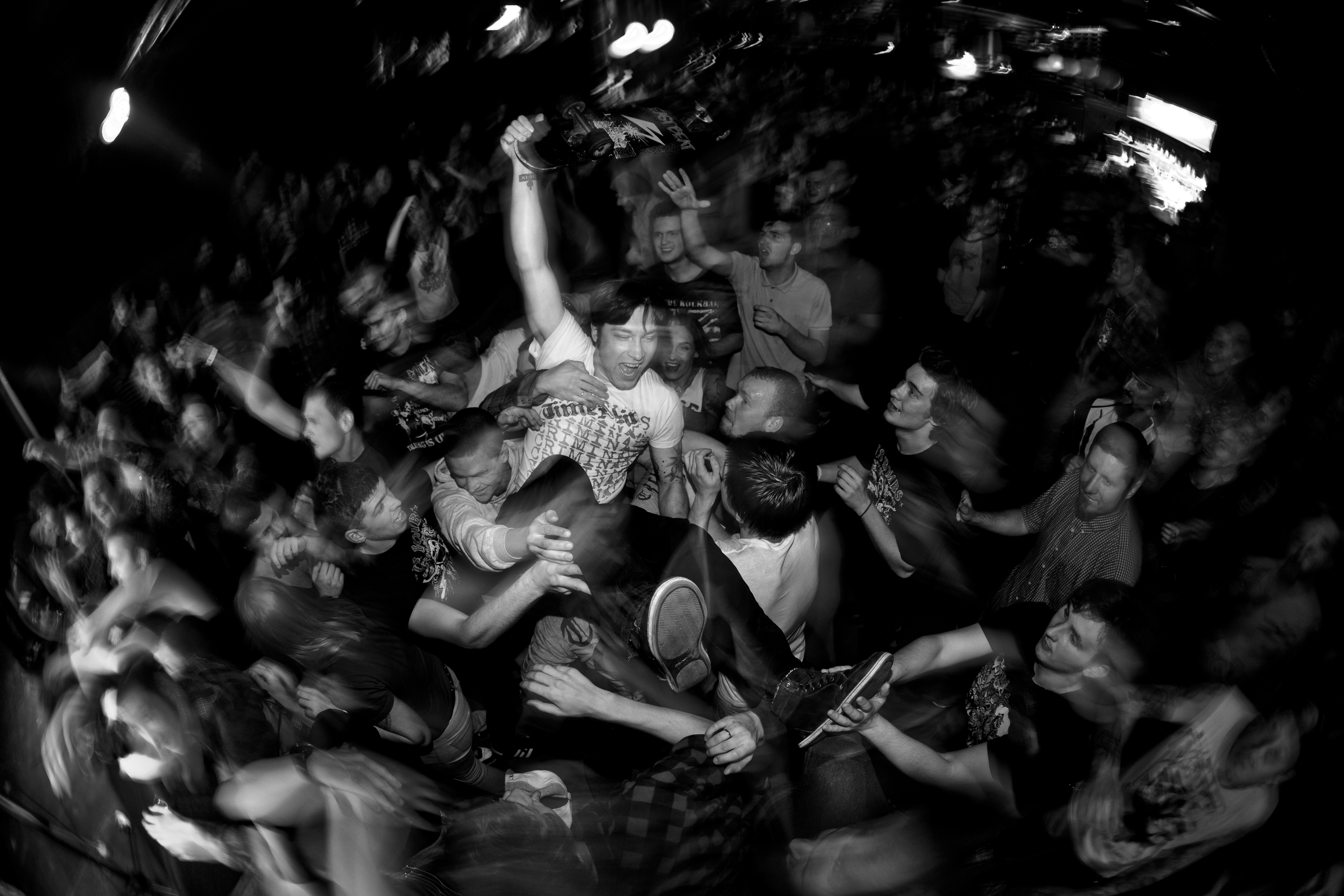
The inherently open and formative nature of D.I.Y. communities unfortunately does not mean that these scenes are safe havens for everyone. Despite the illusion one might get that these communities that seem to be open to new ideas, to those shunned and othered by society will be completely welcoming, there is always unconscious bias present amongst individuals. Additionally, living under the oppressive lens it can be difficult to completely rid ourselves of how we have been conditioned to act due to our life experiences outside of these communities, meaning no matter how welcoming and open a space is, it may not be possible to truly be ourselves without restrictions, even when we can.
Griffin (2012) talks about her experiences in the Punk scene as follows: “From speaking to other women at shows and from my own experiences, it seems that the fear of pain is a concern for some women but there was also a concern to avoid being judged or questioned for taking part in a masculine performance; suggesting another aspect to the way some women experience others' perception of them.” (p. 72) Even in a subculture built on the rejection of the norm, there is still an underlying fear of judgement, in this case, especially among women.
In a space that is still riddled with phobias and bigotry, where one is still unable to rid themselves from societal pressure, it can be hard to express yourself fully. Where you still have the opportunity to do so, it doesn’t mean that the means of self expression is as welcome as it is for those who are more or less favoured by society. Marginalized people may still find it difficult to act out without fearing the consequences of the bigotry prevalent in society, even where it is verbally and artistically shunned, but not effectively and fully.
The music industry, despite the individual works gaining more recognition, still favours cis, white, able-bodied men over anyone else: even when it is simply self-made artists promoting themselves on social media, the algorithm is more likely to push those who are more “acceptable” by the western society standards of presentation and beauty, and people’s unconscious bias against marginalized groups may lead them to unwillingly do the same.
Hyperpop, due to its inherent queer nature, has many prominent trans artists at the forefront: Dorian Electra, Arca, Ayesha Erotica may come to mind. However, the genre is a smaller niche, and although some of these artists have produced songs for more mainstream artists like Charli XCX and FKA twigs, their own works are not perceived or liked by the public. Additionally, unlike physical spaces and communities, it is easier to find and create online communities around marginalized identities, which may not always be possible for shows and concerts.
Conclusion
Anything that involves creativity is a means to shape the world, change it, and reject the current way of things to do better, always. To be creative is to subvert, and to subvert is to go against the norm. With the power to do and to do it ourselves, we take the reigns of production and turn it into something that we can benefit from, rather than we are fed. D.I.Y. in its nature rejects the consumerist culture of capitalism, and powers the individual and community.
With music, the genre of hyperpop with its inherent focus on trans and queer identity, and the highlight of trans artists and producers in the scene, self expression is by itself an act of rebellion, and a way to reject society’s restrictions. Though one thing that should be kept in mind is, however, welcoming and open maker communities are, they are still not free from reinforcing the same norms they are criticising.
Rebellion is born out of challenging the norm in society, and so the same can be done within communities to create a space where not only the marginalized groups and people, but also everyone else part of them will be more welcome and accepted. Challenging norms is a means to create a better life for everyone, even those (and sometimes especially those) who live their lives abiding the rules of society and living in accordance with the norm. Recognizing this will help create a world where differences are welcomed and celebrated.
This paper has touched upon the deconstruction of gender in the scene and what it means to reject the norms, while also recognizing that this rejection doesn’t automatically lead to a space free of bigotry or bias. We are far from creating a harmonious society where everyone is on equal footing, given equal opportunities and care, but by giving more focus to our communities rather than corporations, utilizing the power that we have within ourselves, we can make this world a better place to live in.
References
Butler, J. (1990). Gender Trouble: Feminism and the Subversion of Identity. Routledge, New York, 33.
Griffin, N. (2012). Gendered Performance Performing Gender in the DIY Punk and Hardcore Music Scene. Journal of International Women's Studies: Vol. 13, (2-6).
Luce, M. (2021). The “GEC-effect". Zenith! Undergraduate Research Journal for the Humanities, 5(1). https://doi.org/10.17161/zenith.v5i1.15564
McKay, G. (1998). DiY Culture: notes towards an intro. DiY Culture: Party & Protest in Nineties Britain.
Nicholas, Lucy. (2007). Approaches to Gender, Power and Authority in Contemporary Anarcho-punk: Poststructuralist Anarchism?. e-sharp. 2007.
Pearce, R., & Lohman, K. (2018). DE/Constructing DIY identities in a trans music scene. Sexualities, 22(1–2), 97–113. https://doi.org/10.1177/1363460717740276
Richards, J. (2016). Shifting gender in electronic music: DIY and Maker Communities. Contemporary Music Review, 35(1), 40–52. https://doi.org/10.1080/07494467.2016.1176771
Williams, P. (2021). Beyond the binary: Digital Voices and transhumanist expression in Sophie’s oil of every pearl’s un-insides (thesis). California State University, Long Beach.